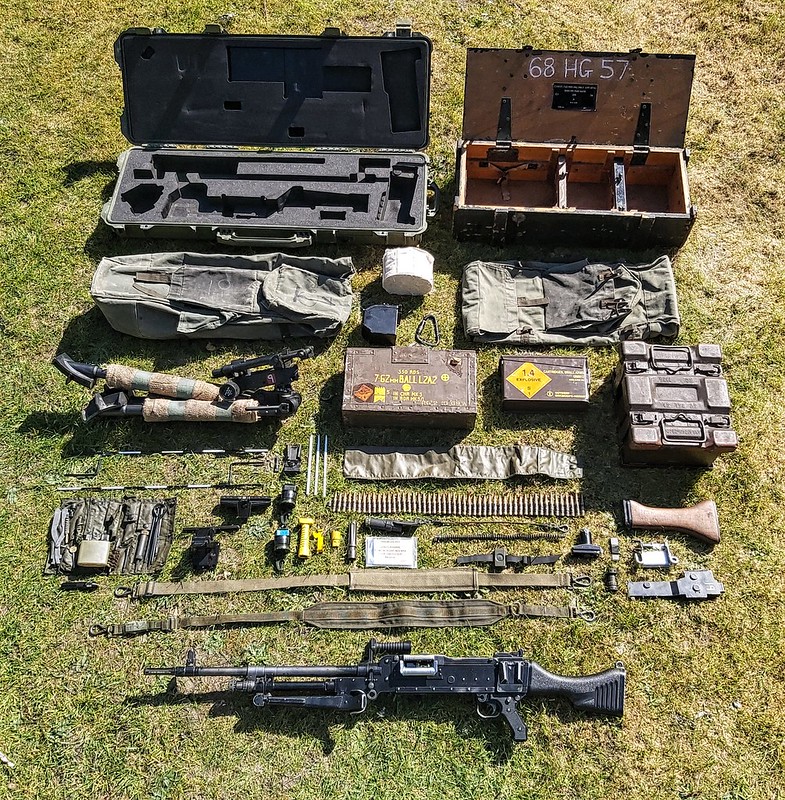
So instead of clogging up the standard pics thread, though it was time to do a separate one specifically.
So this is for any weapon that has/ is seen in use with UK forces.
This is open to anyone wanting to show off builds or get knowledge on the specifics of a British weapon, and so forth.
So I'll start.
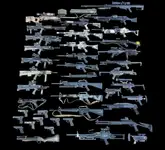
My collection so far.
L9A1 MK2 BROWNING
L9A1 MK3
L9A1 MK3 DS
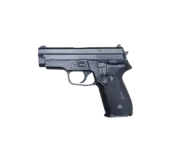
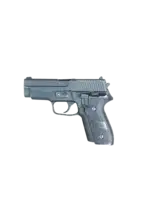
L105A1 - SIG P226
L106A1 - SIG P226R
L107A1 - SIG P228
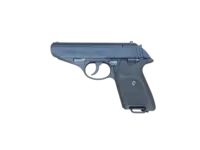
L109A1 - SIG P230
L117A1 - SIG 229
L131A1 - GEN 4 GLOCK 17
L22A2
L85A1 (borrowed)
L85A2 AFGHAN 09
L85A2 TES
L85A2/L123A2 UGL
L85A3
L86A2 LSW
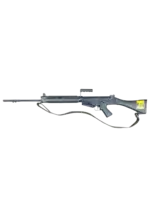
L1A1 SLR
L129A1 SHARPSHOOTER
L115A3 - AI338
L119A1 CQB
L119A1 SFW
COLT MODEL 725
COLT MODEL 715
COLT MODEL 701
COLT MODEL 604
COLT MODEL 603
L2A3 Sterling SMG
L90A1 - MP5K
L92A1 - MP5A3
L74A1 - M870
L128A1 - M1014
L100A1 - HK G3KA4
L101A1 - HK53
MC51SD - SBS
L1A1 66mm - LAW66
L7A2 GPMG
L108A1 - FN MK1 MINIMI
L130A1 - FN 7.62MM Maximi
L2A1 SACTARASS - HK 417
L17A1 - HK M320 UGL
L104A1 - HK69
L135A1 LRPAS - Barrett .50
M79 - "Blooper"
M18 - Claymore
So first up we have both the shotguns.
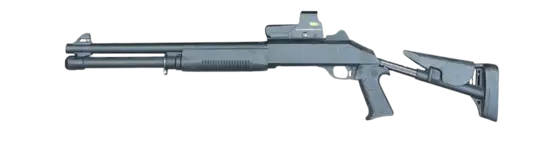
The L128A1, which is a based on a M1014 combat shotgun.
This was brought in during operations in Afghanistan, and I believe it's still in service.
This model is the cheap DE m56 model.
I am planning on doing some work to this to make it a bit more realistic and less plastic looking.
Plus just waiting on someone to do a metal body version. I know cyma did, but front end was wrong.
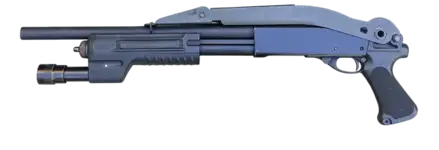
Next up is the L74A1, which is an M870 shotgun. The SAS used both the short and long versions. Was brought in around the 80's and was still seen in use a few years back for door breaching in Afghanistan.
This model is the G&P version, and I've added the folding stock and torch handguard.
The standard end cap was removed and replaced with a genuine one that allows a sling swivel onto it.
Some work to do in this too, but the quality is far superior to the DE.
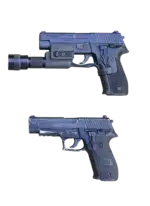
Next on the list is the 2 Sig P226's.
One is the L105A1 and the other is the L106A1.
The difference between the 2 visually is the L105 is the non railed version and the L106 is railed.
The L105 was used by the SAS in the late 80s to early 90s.
The L106 was brought in on a UOR (Urgent Operational Requirement) when we went into Afghanistan. The MoD at the time were looking at replacing the ageing browning HI power for something more modern. But the tender hadn't been released. So the sig was used as a quick fix for a short duration before we finally opted for the Glock 17 Gen 4.
Both these pistols have full guarder kits and steel outer barrel.
The railed version has the full tune up kit and steel external parts. The non railed is still to be worked on.
The L105 boasts a real surefire torch, real early west german grips and early style sig rear sight.
Both surefire and grips took alot of work to fit.
Only work to do on these is on the uppers. Both of these unfortunately are U.S marked, where the British ones came straight from sig Europe. So trades will be filled then possibly cerakoted
Still in the sig family, is both the L107A1 - P228 and the L117A1 - P229.
I have very little info on these pistols other than was used by SAS and close protection teams. But have no pics of these in action.
With mine, nothing special to report on this at the moment. Both are just box standard WE.
I will be looking at getting correct trades done lown the line.
But as I have no pics about of the P228 & P229 in service, it's hard to say what those trades are.
But I would guess european/ West german, same as the P226 came with.
Another rather obscure SIG used in Northern Ireland for a personal weapon or covert ops, was the L109A1 or better known as the SIG P230. These were later upgraded to the P232, before being replaced by the P228/9
Yet again, not alot more info or pics on this weapon. Other than was used extensively before it was replaced.
Mine is the early KSC ABS version. Unfortunately they only did this in the japanese model with sling plate. Well until I can afford to find and replace with a KSC sig P232.
had a steel front sight/gas block made, along with a replica Steel flash hider.
The receiver has been stamped in places with matching serial numbers. Same goes for the fake bolt.
Only thing left is to have a steel barrel made.
Not pictured is I've managed to convert real slr mags to fit and hold the king arms internals and feeds fine.
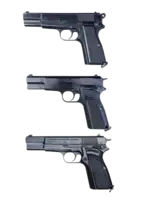
L9A1 Browning HI powers.
the 3 models I have are all the WE versions.
and are based off a MKII, MKIII early & MKIII late version
The MK2 was made some years ago long before WE released their MK3 model.
For this MK2 build, I had to remote the original gp35 style rear sight, which was a pain!. Filled the gap with a putty called quiksteel, then smoothed down the upper to match the slimmer (later) profile Slide.
I then added a genuine sights, sling loop and real mk2 grips.
Both the grips and frame have to be altered a bit both both will marry up to a degree.
I then went and had the correct L9 markings added to both upper and lower.
Only issue was they were supposed to fully engrave it. But wires got crossed and they only laser engraved it. But will just have to live with it for now.
Now both the MKIII's, these were purchased with the markings already done.
Only differences between the 2, the early type (more side markings) now has real MK3 grips and rear sight.
This version comes with a genuine HK LLM01 adapted hand guard. This was only seen for a short period with some units before the DD rail was adopted.
This rifle is based off a mates unit, who served with the paras. So all labels and marks are exactly as placed on his rifle during his tour. All I did was change the butt number.
Then weathered the hell out of it and spent alot of time making the susat look real.
This is still on my to finish list. The rifle itself needs alot of work. The launcher on the other hand has had the end of the launcher lathed down to resemble the real end and can now correctly fit the genuine dust cap.
I've also had a real LLM01 pressure switch holder fitted, and re worked the side rail and bolts.
I'm looking at getting the trades removed and having correct ones re laser engraved.
Then will get the same weathering treatment as all the others.
The barrel on this is a rare (unknown brand) Steel with stampings. The heavy section of this barrel is a collar and can be removed, so had a more accurate collar made.
The flash hider unfortunately for now is a TM aluminium one, where i am hoping to be able to source 2 steel 14mm negative flash hiders for both of these.
Gas block is an original Army Code steel one, not the later Warlord tactical one. This also has a real circular type sight post fitted.
CQB
This has just a standard G&P barrel on for now, but do have a steel Guarder barrel waiting to go on. this is once ive managed to source a steel flash hider as mentioned above and also a steel type front sight block, as the one fitted at the moment is just a standard G&P one with the bayonet lug removed as per the real thing.
Both rifles have real AR end caps fitted along with the Guarder Real delta rings.
RAILS
Both rails are genuine KAC ones, however they are actually different!
The CQB has a standard type fitted, where as the SFW has the UK spec fitted.
Now the difference is, that the standard type only has one screw located on the top rail at the back to retain against the delta ring teeth.
On the UK spec type, they also have one fitted on the lower rail to allow for the weight of the UGL, so it wont fall off if the delta ring is caught or slid back.
All panels and grips are genuine KAC ones.
RECEIVERS
The SFW one is an original dragon red, which comes engraved with correct markings from new. The CQb however is a G&P which has had to be engraved.
Both have the correct key hole cast marks added along with the correct rail adaptions done.
The alterations to both receivers are:
Angle added to front section of rial.
Extra slot added at rear of rail.
the rail sides at rear have been made shorter.
A drop/angle added at rear just above the carry handle.
They both have the G&P small steel parts fitted.
GRIPS
The Sfw has a Guarder large AR grip fitted. these are nice for the larger hand guys like myslef, and is more realistic looking along with accurate markings. only down side is that unlike its real counterpart, it doesnt have the trap door on the bottom leaving the standard AEG motor plate visable.
The CQB has the G&P storm grip, which I find ok but not comfortable. This is since the sides are flat, not rounded like the Guarder. It's also missing markings. only saving grace is that it simulates the trap door like on the real.
I did try to alter a spare to fit the Guarder, but its too different and would require extensive modding to point of it been unusable.
Just wish someone would make a more accurate one for a AEG.
STOCK/TUBE
So both stock tubes on these are the G&P ones, with the HAO canada type locking rings on (not pictured)
The SFW has a real Diemaco sling plate added, where the CQB now has a real magpul ASAP plate (not pictured also)
Both stocks are real with real butt pads, however the SFW has the correct Diemaco textured stock. The CQB has the normal CAR type stock.
I do also have a spare Warlord tactical butt pad, and tbh, its pretty close to the real one.
SIGHTS
SFW has a genuine Diemaco D.I.S carry handle, where the CQB has a genuine Matech BUIS, but a cheap clone TA01 ACOG for now.
The CQB also has a G&P PEQ2 fully working for now, but am looking to upgrade in the future to the PEQ15.
I'm not a fan tbh, if money was permitting I would rather GBBR versions.
The L92 is a correct setup of the MP5's used during the Iranian Embassy siege.
it has a genuine mount and torch, which is the streamlight SL20. Most people get this wrong and say they are maglites....... this is not the case!. Maglites came later with a special mount that had them mounted underneath the slim A3 handguard, which was the precursor to the later surefire handguard.
As for the rest of it, there have been a few changes. Drilled out the body pin holes to fit real push pins. A steel Guarder cocking lever and custom steel tube made.
The rear sight is a steel upgrade along with a Guarder steel early trigger (not pictured). Also a steel front sling loop and early steel flash hider fitted.
A special adapter had to be made to fit the real A3 slim handguard. With the classic army/Tm and similar clones, the receivers are a tad too short. Where the WE/VFC GBBR will fit real grips no problems.
The L91 is pretty much standard, other than adding a genuine surefire torch and L.P.E sd mount onto it.
The scope isn't quite right, but left this on for now till I source the correct Aimpoint scope.
The scope fitted at the moment is a Guarder 4x28 tactical scope (NB-28), which is a clone of the Hensoldt Z-24 scope mounted to MP5 & G3 platforms.
Here I have started to build a colt model 604, As issued to the British army in the late 60s, early 70s.
So the Model 604 is a slight variation from the original model 602 (XM16/M16 VN)
The 604 comprises of a XM16 stock with a pivoting sling mount. Not the static version fitted to the later model 603 (M16A1)
Compared to the model 602 (M16 VN) which had a slab side, and the full fence of the model 603 (M16A1). The Model 604 used a partial fence.
Now despite being upgraded internally the same as the 603, the externals pretty much still resembled the 602, with it's 3 prong (duck bill) flash hider and lack of forward assist.
The British version differed from it's U.S. counterpart, and only had the standard colt export markings.
As Well as being painted black with a paint called Suncorite, which all UK weapons had at the time.
Now mine is still a work in progress.
Ive had the markings filled.
I'm still to source the correct rear sling mount.
I then tried to replicate the suncurite paint best I could. As the real paint was just slapped on. I tried the same but in the picture below, looks smoother than it actually is.
Only other thing is slings.
Early version came with AR15 slings. But very quickly guys swapped these out for L1A1 SLR slings. So will look at that in the future too.
The model 603 is what later came to be called M16A1.
The ones issued to UK forces was the Colt export version.
These became the go to weapon for the SAS In many theatres for some time.
The difference between this and other AR platforms in use,
The 603 had a forward assist, aswell as a full fence side. Compared to the non forward assist AR's in use like the 604 (partial fence) and the early 602 used in borneo (slab side)
They also did away with the duck bill flash hider for the standard A1 type and a phosphate bolt, where 604 and 602 were chrome plated bolts.
Mine is a take on ones seen sprayed/taped during jungle warfare and the odd ones seen during the falklands.
Only thing that is left to sort on this, is to get rid of the standard markings and get the Colt M16A1 export marking ls added.
And for those looking for the extra little details.
The 603s had their serial number crudely engrave on the left side l, inside the carry handle.
Mine is a take on the minimis used by the ill fated SAS team "Bravo two zero" during Gulf War 1
The pic below is their actual weapons that were captured!.
The weapon system itself was just a standard Mk1 minimi. You may notice in the pics there is one difference!
it was fitted with a gpmg flash hider.
Which was also adopted by the Australians on their minimi's. (Designation F89)
The L108 was only ever really used by the SAS. It was some years later before the minimi would become issued among the regular army. But that was the PARA version which was later designated the L110A1/A2
However the L108 was, and believed still is held in stores.
My L108 is an original TOP M249.
Has been upgraded externally with
Guarder steel gas block & front sight, guarder steel upgrade body parts, guarder steel barrel/top cover block, g&p steel cocking lever, g&p steel bipod.
Replica steel gpmg flash hider.
I will eventually get round to doing internal, and convert the original gearbox over to a classic army one.
WARNING.... EXTREMELY LONG READ!!!
I've tried to keep this as short as possible without losing too much needed info. An even deeper version will be done at a later stage, which will also focus on the early FN and newer HK versions.
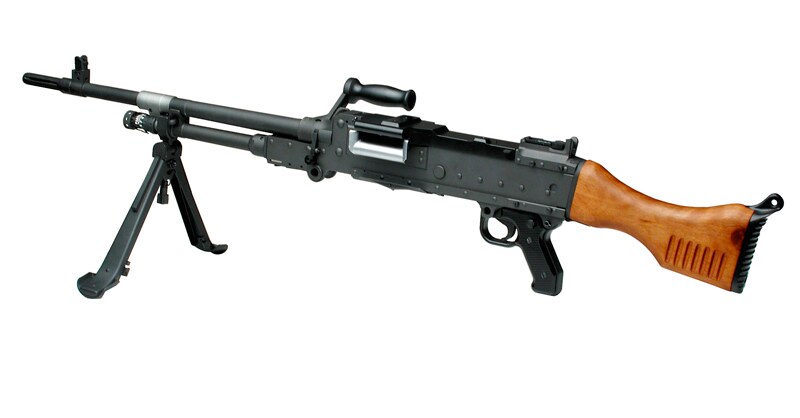
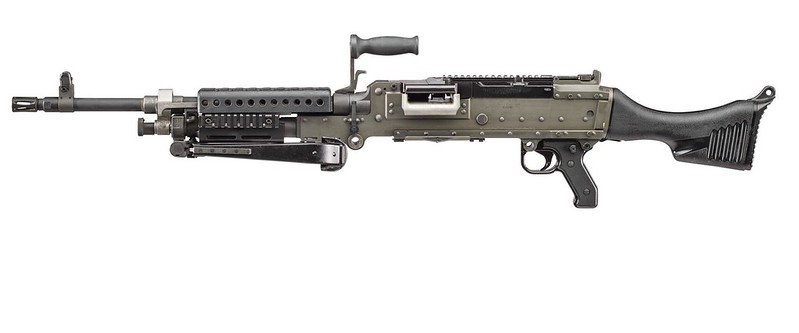
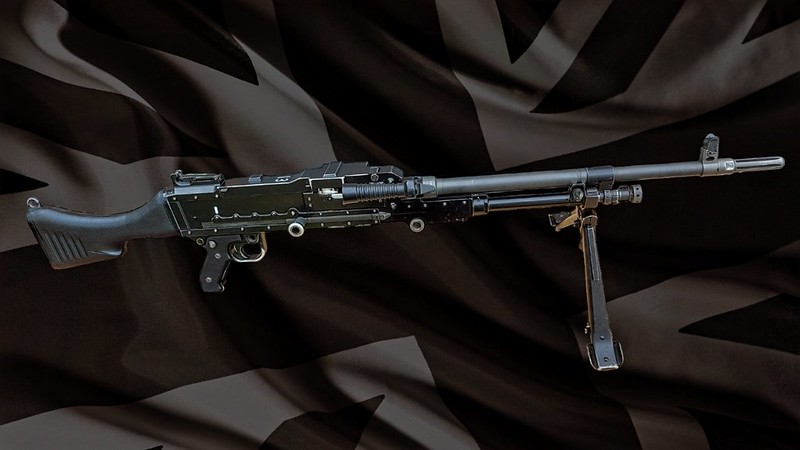
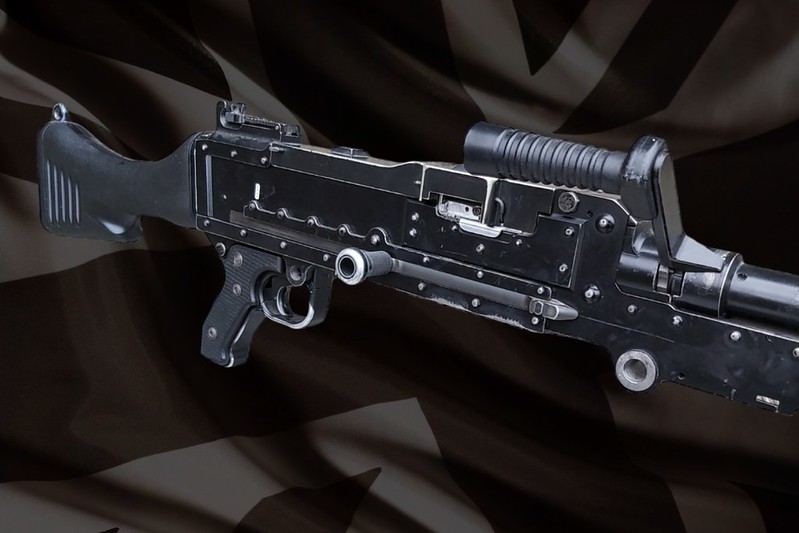
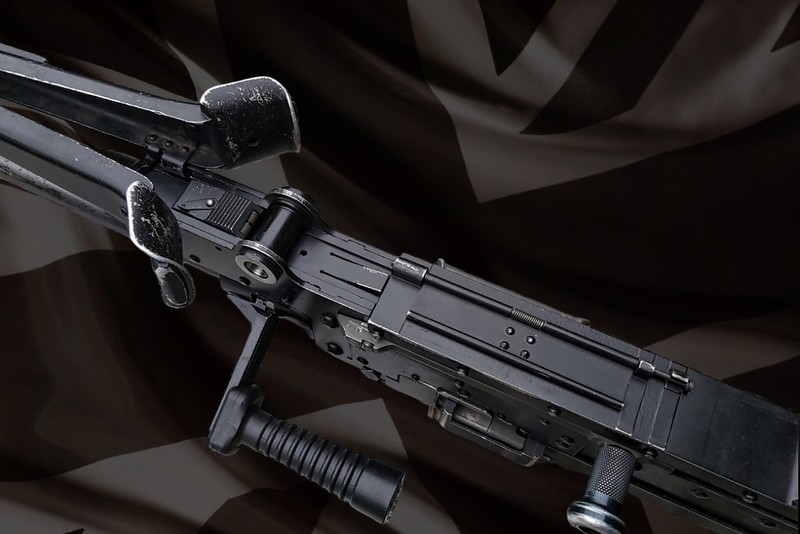
This is a complete custom build, made of full steel, and is currently 99.9% accurate to a real L7
I know that for some of you, who have seen some of this build before, we’re covering old ground - but please don’t run away just yet!
Now, with the final piece of my puzzle, an accurate custom made steel barrel arriving. I've decided it was time to sort it all out, and refresh the build for a more informative experience. And to help explain why the L7 isn't just another M240.....
Also, having done so much research over the course of this project, I’d thought it was time to share some of what I’ve learned and hopefully shed some light on why the changes I’m making were necessary. I’d also like this post to be able to aid others in their builds, and to hopefully shine a light for those with a particular eye for detail upon the things that might otherwise be overlooked.
So, let’s begin.
The basis for this project was originally an Inokatsu’s M240B. However, over time, this changed, and I had to have a completely new body and barrel made due to the amount of differences. The old inokatsu bits ended up being used in exchanges of parts.
So as I got thinking about making a British variant, I did decide to do a bit of light reading (so I thought) - and I was completely astonished by just how much history surrounds the GPMG.
So, for the history lesson!
THE FN MAG 58
The first Fabrique Nationale d’Herstal (FN) MAG was designed in the early Fifties by a guy called Ernest Vervier. It combines the trigger mechanism and belt feed system from the WWII-era German Maschinengewehr 42 (MG42) with a more updated take on the gas-operated mechanism from the WWI-era American Browning Automatic Rifle (M1918 BAR). It was called the MAG 60-20, later the ‘MAG 58’; MAG being the acronym for "Mitrailleuse d'Appui Général’ or “Mitrailleuse á gaz”, French for ‘General Purpose Machine Gun’, and “58” denoting the year production commenced.
The 3 primary MAG variants were:
• MAG 60-20 Infantry version
• MAG 60-30 Fixed aircraft version with either left or right feed
• MAG 60-40 Coaxial version
Specifications:
• Calibre: 7.62x51mm NATO
• Action: Gas operated, open bolt
• Feed: NATO M13 ammunition belt or the non-disintegrating DM1
• Weight: 10.9kg (24Ib)
• Length: 1,232mm (48.5 inches)
• Rate of Fire: 625 - 900 rpm
• Muzzle Velocity: 838m/s (2,749ft/s)
• Range: 800m (2,625ft, light role) - 1,800m (5,905ft, sustained fire role/tripod mounted)
THE L7
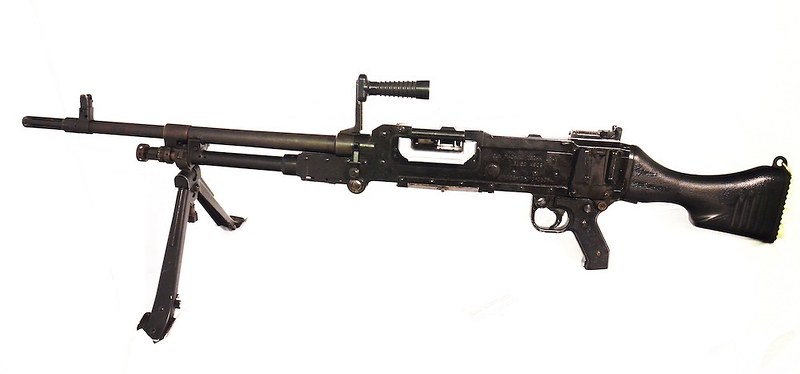
The original British variant of the MAG 58 (technically the MAG 60-20 T3), the L7(A1), was brought into service in 1957 and produced by FN. Then in 1962, under license by FN, the Royal Small Arms Factory (RSAF) in Enfield Lock, took over production making further improvements and incorporated into the L7(A2) (MAG 60-20 T6). In 1984 the RSAF became Royal Ordnance Plc., which four years later was bought out by BAE Systems, resulting shortly thereafter in the closure of the original site. After that, it fell to several sub-contractors, notably Manroy Engineering (now FN UK), to oversee both the production of spare parts, and general refurbishment of the GPMGs until mid-2008.
In late 2008, Heckler & Koch were given the contract to produce all spare parts and accessories, having had the task of producing new barrels for the gun since 2003. In 2011 HK won an additional three year contract for a mid-life improvement program (MLI). In 2008-09 the MoD solicited tenders for manufacture and support of the GPMG; by this point the original design copyright owned by Fabrique Nationale d’Herstal had expired. The three main respondents were HK, FN, and Manroy. The tender required the entrants to submit guns for testing, with HK’s version being the most publicised. Finally, after years of testing in the laboratory, training and in the field, in late 2014 the MoD announced that HK had won the contract to produce the L7s and their spares for the next few years.
The L7 GPMG, nicknamed “the General” or “the Gimpy” (pronounced ‘Jimpy’), has seen every British military engagement since entering service, including action in Aden, Borneo, Rhodesia, Northern Ireland, Oman, Falklands, Bosnia, Kosovo, Sierra Leone, Afghanistan, and Iraq.
THE MAG 58 WORLDWIDE
Over 200,000 examples of the MAG series and other variants have been used by more than 80 other countries over a similar period under different designations.
For example:
• Austria - 7.62mm MG MAG/Pz
• Argentina - 7.62 ametralladora Tipo 20-60 MAG
• Brazil - M971
• Canada - C6
• India 7.62 2A1
• Indonesia - SPM2
• Republic of China - CQ 7.62x51
• Sweden - KSP 58
• Taiwan - Type 74
THE M240
America did eventually jump onto the bandwagon, but relatively late and not until it had designed its own version of the MAG series. Known as the M240, it was put in service in 1977 and was used only as a co-axial variant fitted to armoured vehicles. An infantry variant - the M240G - wasn't introduced until 1991 by the USMC as a replacement for the dated and unreliable M60. The US Army adopted the weapon in 1995 as the M240E4, later the M240B. As in British service, several variants were to follow, including the M240C, M240D (E1), M240H (E5) and M240L, which is a new lightweight variant. Compared to the L7 the M240 infantry variant has only seen a few engagements mainly, Somalia, Kosovo, Afghanistan and Iraq (1991 and 2003).
THE PARTS
Like myself at first, many people don't realise just how different the L7A2 and M240 are, despite being the machinegun equivalent of siblings. After extensive research and months spent studying plans, photos and parts lists, I was left with a list almost an A4 page long of parts and work that would be needed to turn my M240 into an L7A2. Over the course of a few years, I gradually acquired all the parts necessary to complete the build.
They were:
• Inokatsu original style replica flash hider
• Barrel washer
• Foresight & Foresight block (early type)
• Sling swivel
• Bipod with height adjuster
• Bipod retaining latch
• Gas block & gas plug replica
• Gas regulator
• Top cover
• Top cover plunger
• Top retaining bolt and castle nut
• Carry handle assembly
• Barrel release catch
• Cocking lever and knob
• Feed tray
• Ejection port cover
• Trigger Group retaining pin
• Rear sight aperture and slide
• Trigger grips
• C2 sight side mount
• Stock
• 50rd belt tin
• Sling
Later came things like my tripod, carry cases and all the other ancillary parts associated with the gpmg.
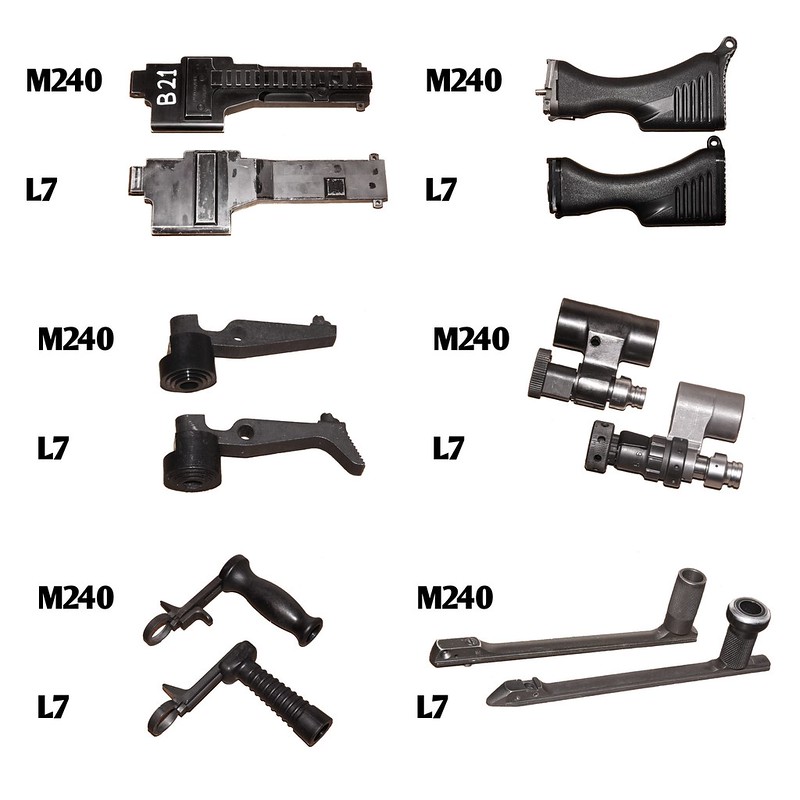
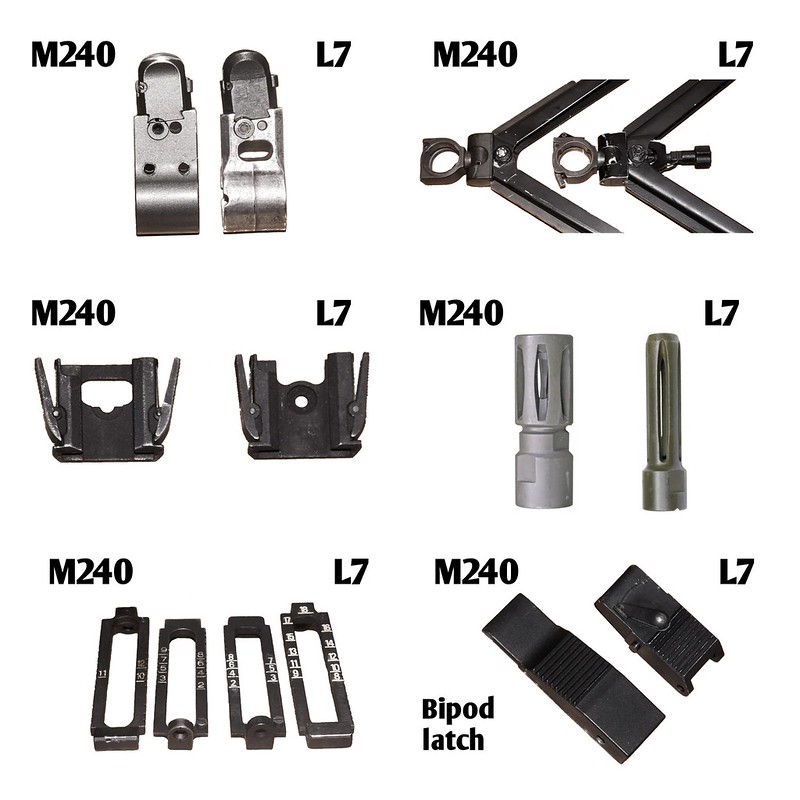
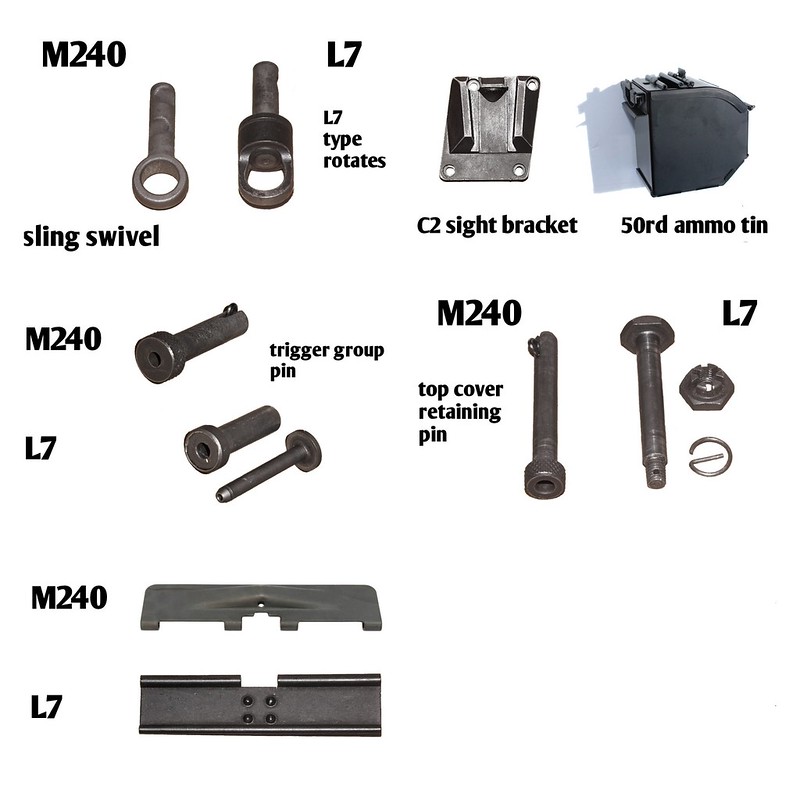
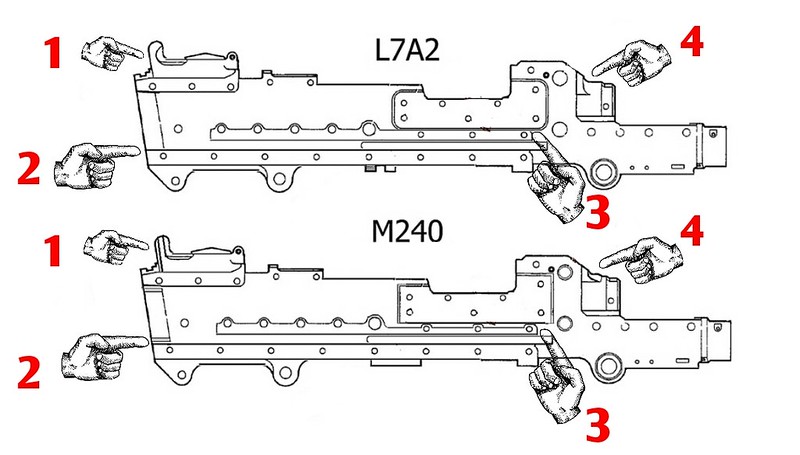
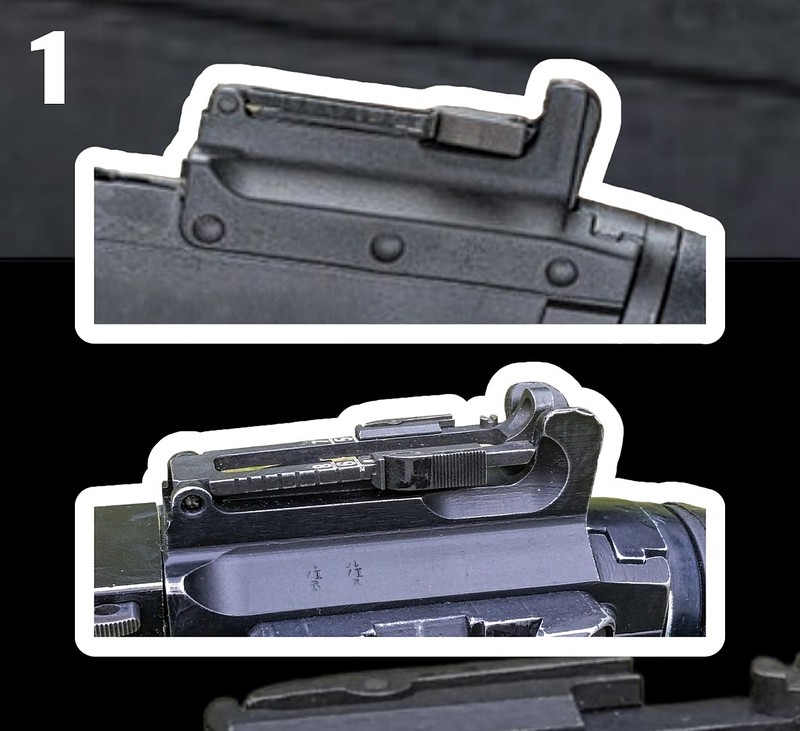
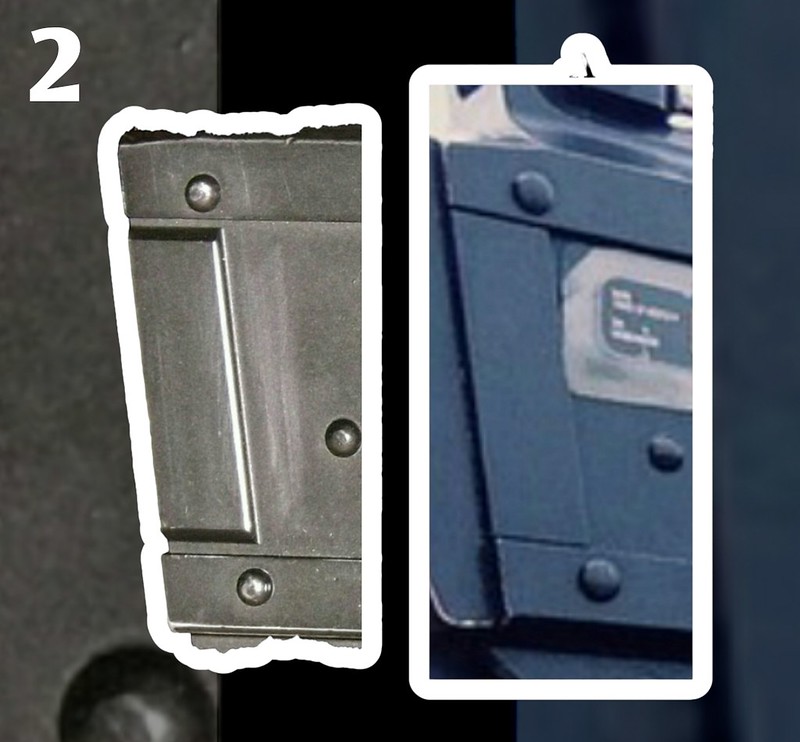
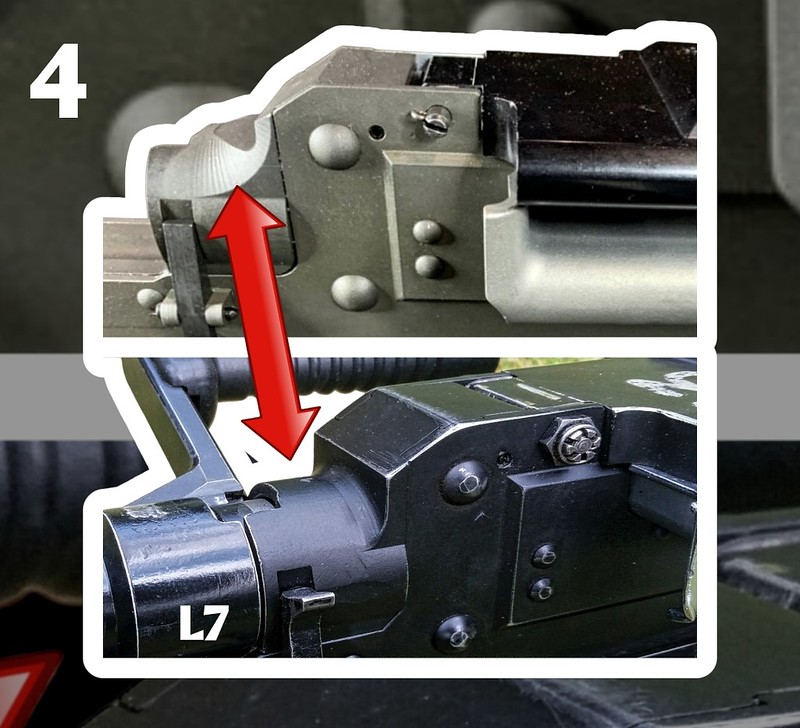
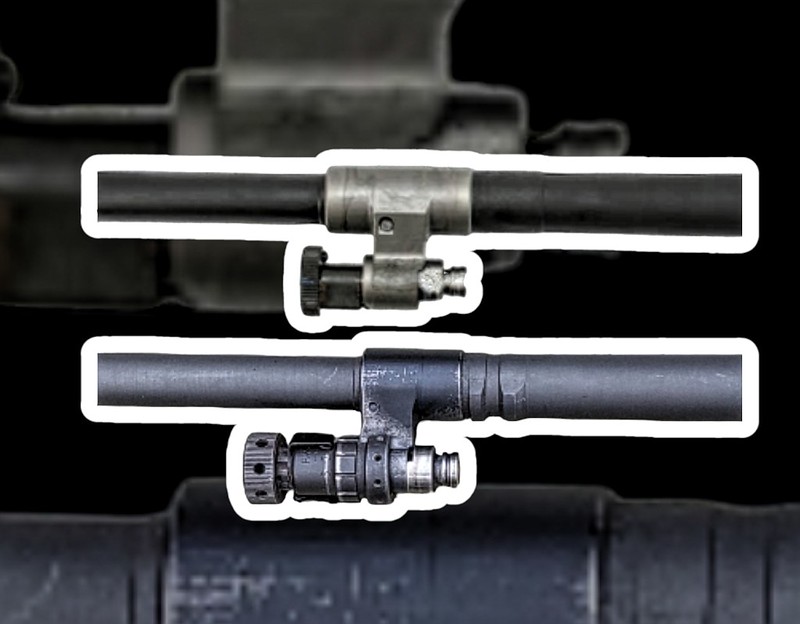
As the build started to unfold, I took the opportunity to actually show you some of the major and minor differences between the L7 and the M240 parts, to help explain why I needed to change or alter so many of them.
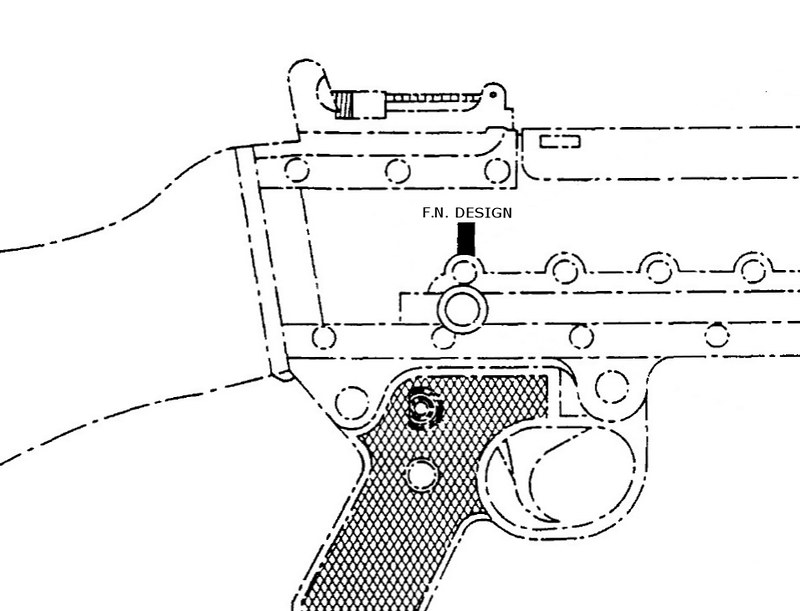
Now, not just the parts, but even the body differences are quite drastic.
• Rear sights
(M240 straight, L7 curved with finger grooves)
• Reinforcement for stock on side plates
(M240 bigger gaps, L7 more Reinforced)
• Cocking lever support bar
(M240 grooved, L7 more reinforced)
• Front trunnion
(M240 has a small ridge, L7 rounded)
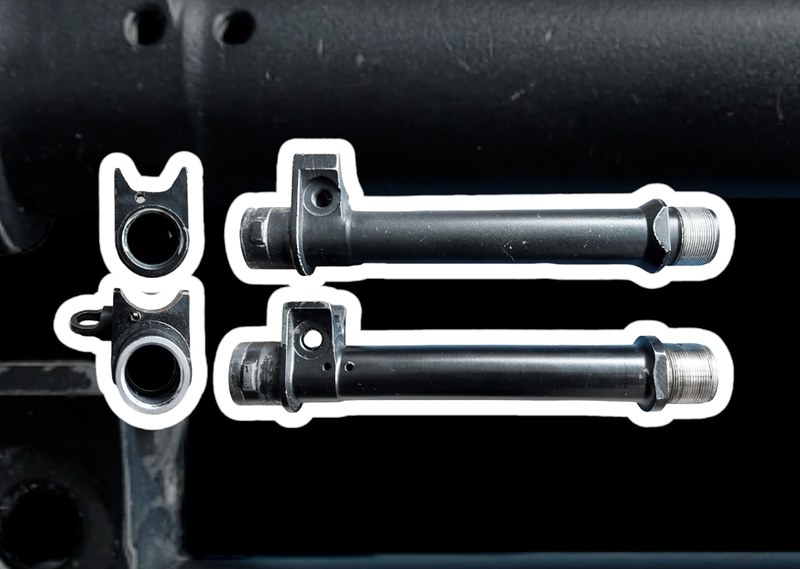
• Gas tube
(M240 has large rear section, L7 slimmer rear and 2 vent holes. Also to note the L7 variant has grooves both sides to allow for an ambidextrous mounting of sling swivel. M240 will only sit on the left side)
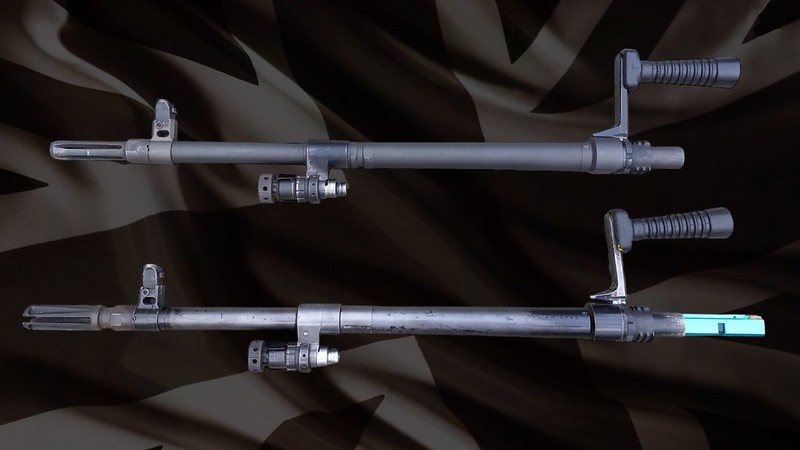
• Barrel
(M240 is smooth behind Gas block, L7 has 2 grooves that allow for a better seating on Gas tube)
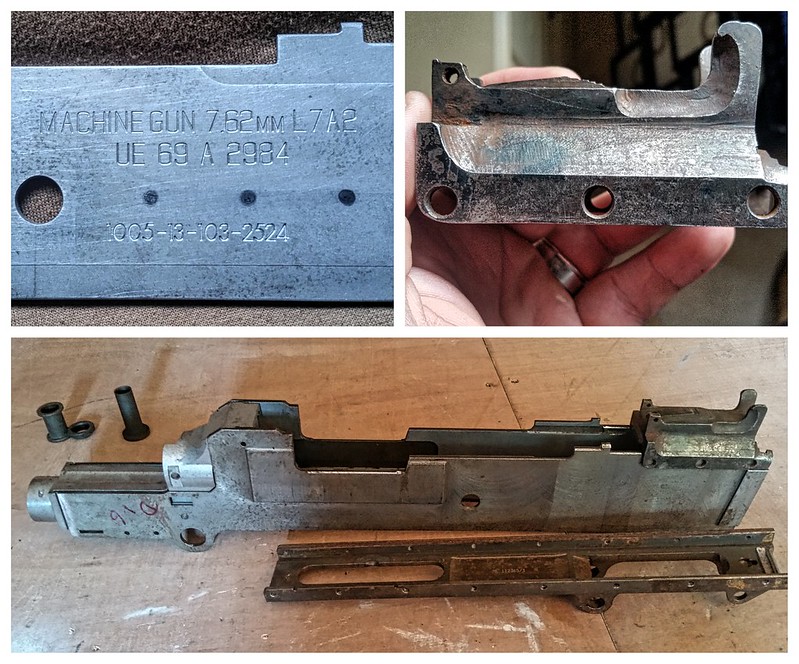
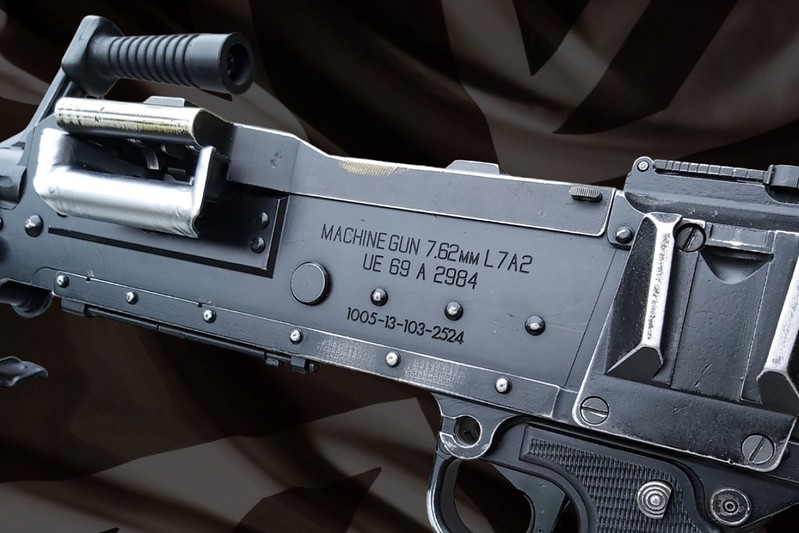
MARKINGS
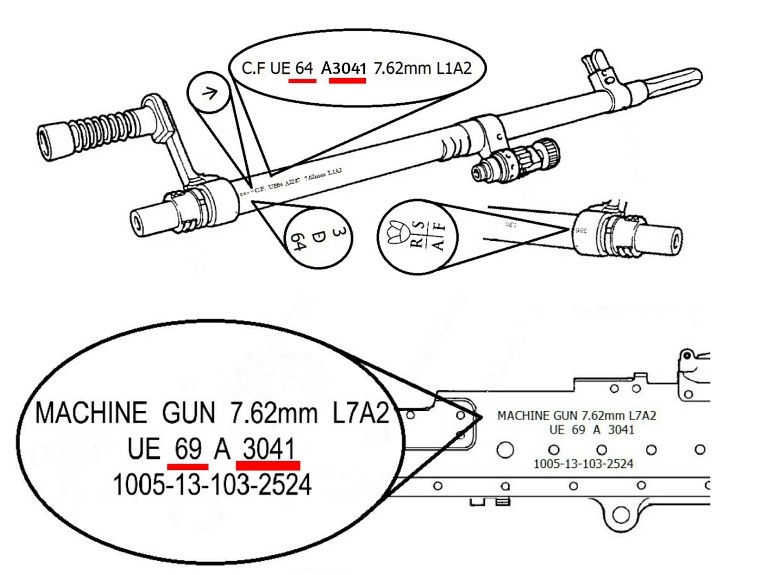
The top row speaks for itself; the next row is the first important bit.
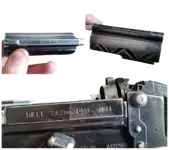
The first two letters denote the country then factory; "BL" for ‘Belgium Liège’ (meaning the gun was made by FN), "UE" for ‘UK Enfield’ (meaning the gun was made by RSAF), Additionally, "HK" for ‘Heckler & Koch’ along with their test batches will be engraved on all future GPMGs.
The next two numbers denote the year of manufacture, e.g. 75 for 1975. The possible combinations are 57-73 (BL), 62-88 (UE) and 08-11 12-present (HK).
The "A" prefix is a batch number and was just added to the sequential sequence to allow the 4 digit serial number to remain (e.g. A0001-A9999, then rolling over to B0001 if the production for an individual year exceeded 9999 guns). Then next the four numbers are the last four digits of the weapon’s serial number. Newer Heckler & Koch made examples have 6 digits followed by three proof marks.
The bottom row of numbers is the NSN (NATO Stock Number) for the weapon. The NSN is a 13-digit code used to identify more or less everything purchased by NATO forces. Individual components and whole weapons are listed (for example, the GPMGs carry handle alone consists of six individually-NSN numbered parts; the entire assembly is also listed as a single NSN). The weapons themselves are listed whole:
Early Barrels ( before HK) were stamped with a “L” designation along with the weapon’s serial number, which should be within 6” of the chamber on the right side using a 5-6mm (⅛”) stamp. This would normally be the weapon’s full serial (‘UE84 A2912’) and barrel calibre.
So the infantry barrel was designated L1A2.
My original barrel has been done, just need to get the new steel one done.
The reason why barrels are normally stamped with the serial number is because each barrel is paired to a specific parent gun, and not supposed to be used with other guns. This is because of cartridge headspacing (CHS) matching between the barrel and body. So over time the barrel locking thread on the body wears, and to counter this various size locking nuts with different thread thicknesses are in use.
On the locking nut itself, there are some serrations that the barrel locking latch will use to keep the barrel from coming free, and these cause the latch to click repeatedly as the barrel is locked home. The number of clicks is important - the minimum is three and maximum is 7 - as it demonstrates whether the barrel nut is too worn. If the latch clicks fewer than three times, the barrel will not be held or locked sufficiently. If it clicks more than 7 times, then the thread on the gun has become worn and the locking nut must be changed for the barrel to stay positioned correctly. Because one gun may have to use barrel nut size 2, it may fit perfect on that gun, but it will possibly be too tight or too loose to fit onto another gun; hence, the pairing arrangement.
PAINTING
Early gpmgs were painted with a paint called Suncorite 259. This was then changed in mid 2000s, having been phased out under new EU environmental regulations. All contractors - the likes of Manroy and HK - are now free to use their own firearm coatings, so long as they meet the standard, which in the UK is called ‘DEF STAN 80-56’. Mine was sprayed with what’s called ‘Small Arms Black’. However, I have also sprayed parts with Halfords satin black and can tell you there's not that much of a difference.
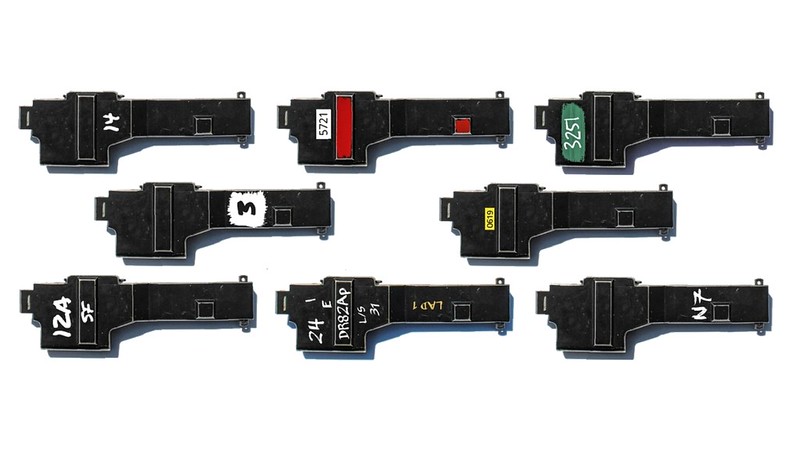
BALANCING MARK
On British GPMGs they have a white line placed towards the rear right side of the weapon, called a balancing mark. The white line corresponds to the position the cocking handle should be in when ‘balancing’ the weapon. It acts as a visual guide to show where the working parts make contact with the second sear (the former being the safety sear). The safety sear was put in on later models to stop what’s known as a ‘runaway gun’, a condition where the bolt doesn’t engage the sear and the gun will fire uncontrollably without trigger input until the ammunition is exhausted, you have a stoppage, or bits of the gun begin to melt.
These would be placed from new or fresh refurb, when the weapon was balanced with it’s parent barrel, and its spare barrels matched. The mark can vary in size with Tippex or a white paint pen. The line itself will always be placed directly above the last rivet.
UNIT MARKS/BUTT NUMBERS
These are basic armoury numbers for quick counting and easy identification, and are normally referred to as “Butt numbers”. These are most commonly found on feed covers & buttstocks. The numbers are there for ease of retrieving a particular weapon from the rack. For example, L7A2 BL69A073249 could be rack number 55. It’s easier, when looking at a rack of 100+ weapons, to just grab the one with the big 55 number on it, instead of having to go through each weapon to check for the serial number.
These would often just be written on with a paint pen, but is becoming more common to see them done with a label machine.
Other number/marks will include:
Vehicle or unit call sign, e.g. "10B", "33A", "24C" with the exception of "11" and "22" in an armoured battalion.
The number plate if mounted on a vehicle, as has been seen on some wmiks in afghan.
"Sf(followed by butt number)" if part of a Support fire role (with tripod)
Zap number; the individual soldier’s casualty identification number, this is the first 2 letters of the surname and the last four from their service number. For example, Davis 25015598 would be DA5598. Some people had this written on a bit of scapa/sniper tape, which was wrapped around the stock just in case in Afghanistan, but it was not standard procedure.
Units have also been known to paint colours on the top covers. This is sometimes done to identify a company or squadron within a regiment, battalion or battle group. Coloured patches are normally placed on the top cover, and although it’s not commonly done, it is more often seen on L85s & SUSATs
The usual main colours are red, green, blue or yellow.
I've kept mine simple, and just added the number "13".
Originally I had it marked with red to symbolise A COY 3 PARA in afghan 2008. But later removed it.
Barrels
Some times the carry handle is marked to determine if its the main, spare or even blank barrel. Some are even marked with the weapons serial or sf number.
I've added the number "1" to mine to determine its the main barrel.
GEARBOX AND FEED SYSTEM
Having devoted so much of this thread to the externals, it's time to show the beating heart of the beast. The gearbox was originally built up when I purchased the M240. Since then I’ve had to replace a few bits due to general wear and tear, but this is how the internals stand at present:
Guarder SP110 mainspring
Ultimate piston head (ventilated hexachrome aluminium)
Systema Area 1000 v.3 cylinder head
Systema Area 1000 Teflon cylinder
Systema Area 1000 oilless 6mm bushings
Systema Energy v.3 tappet plate
Systema v.2 flat gear set
Systema Jet AK nozzle
TM AK hop-up chamber parts
Madbull Blue hop-up rubber
TM EG1000 short-shaft motor
TM 509mm (M16-length) inner barrel
It currently chronographs at 337fps with Blaster 0.20g BB’s; consistency is excellent and the range is wicked on 0.20's, although trying to get it to fire individual shots is very hard as it’s either safe or cyclic! I've kept the standard barrel on this and not upgraded it for the simple reason that I want to use it how a support weapon should be used. With work I could have it DMR accurate, but I like to harass a whole barricade, not just one person.
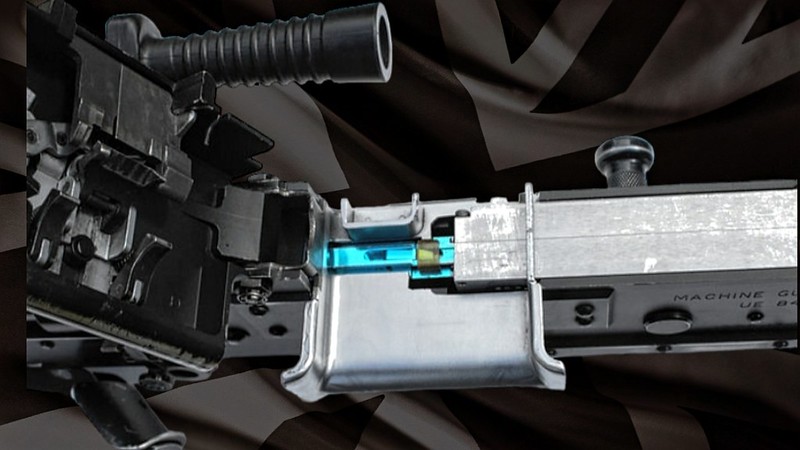
The inside of the Inokatsu is a fairly typical AEG gearbox; what complicates the gun is - as usual for box-fed airsoft guns - the feed system. I had originally wanted to use a G&P M249 auto-winding box magazine. Unfortunately, after receiving a donated one I found that the mechanism itself was just too big to fit into the smaller 50rd ammunition tin fitted to my gun. I looked at other types of box and drum magazines, but nothing stood out until a forum member approached me with a spare Echo1 M240 box magazine for sale. Having received it, I promptly ripped it apart for the feed mechanism. Unhappy with the wiring I decided to strip the G&P box for parts too, and soon a Frankensteinian monster was in the making.
The chief reason for trying to marry the G&P’s electronics to the Echo1’s mechanics was my decision to power the gun with a 9.9v LiFe. The Echo1’s harness is made of extremely thin wire, and I’m worried that the stress of long bursts of fire may cause it to overheat. The G&P harness is heavier-duty, and also has a circuit board with an integrated transformer to vary the battery’s high voltage to the lower voltage required by the winding mechanism’s motor. Usefully, the circuit board also continues to wind the magazine for a few seconds after you release the trigger, ensuring there are BBs fed for the next burst. I cut and bent a metal plate to act as a makeshift reservoir, and cut a rectangle in the side of it to hold the LiFe.
I'm still looking for other ways to store the battery, so this isn’t necessarily final. I also tried to think of a way to hide the feed tube, but there wasn't enough room to do so; for the moment at least I've had to stick with the feed sticking out the bottom. The feed tube may have been too big but the wiring wasn’t, so that has now been hidden after making a cut out in both the body under the feed tray and on the edge of the ammo box lid. Bear in mind that this magazine is really only a prototype and still under development. I need to make sure things work reliably, and I would like to simplify the wiring at some point before I make something more permanent
Hope you've enjoyed this build and all the info that makes the L7 unique, and you haven't fallen asleep yet.
It has a genuine mount and torch, which is the streamlight SL20. Most people get this wrong and say they are maglites....... this is not the case!. Maglites came later with a special mount that had them mounted underneath the slim A3 handguard, which was the precursor to the later surefire handguard.
Trouble is with alot of embassy images and even task force black stuff. So many people have recreated it or done impressions of it. That when you do search for images, ends up flooded with airsoft or reenactment pics instead of real deal ones.
And unless you know what exactly to look for, it can be very confusing.
I don't have the detailed knowledge about the specifics of pews I have & those with a close or a tenious connection to the British armed forces, so be prewarned... what I think I have is potentially wrong/incorrect.
L96A1/L115A1 springer, bought as a basic two-tone before my ukara & now painted to resemble the Green Meanie.
L96A2/L115A2 springer, another cheap wallhanger I've rattle canned with a 'Kewl' desert pattern cam.
L96/Arcti Warfare, left stock & un painted simply coz I like it as it is.
SMLE mk3, springer, previously a tow-tone but cleaned up fairly well by the previous owner.
Thompson 1921, a denix replica in full 'gangster' mode with 50 rnd drum mag.
Thompson M1A1, a rattled ex two-tone which needs a much better paint job.
Sten mk2, denix replica (weighs a bloody tonne, in fact all the denix stuff is heavy).
MP5SD6, retractable stock, had one years ago & craved another one.
MP5, hard stock.
MP5, based on an Iranian Embassy pic with slim hand guard,retractable stock & humungeous SL-20XL torch on a crane mount.
Mp5K
Sterling mk4 L2A3, rubber prop, Cleaned a couple in the TA in my youff but never got the chance to fire one (as a chef in the ACC attached to the RA my spatula skills took priority).
Steyr Aug, does the Falklands defence force count?
EM2, rubber prop but cool as F*^k.
L22A2, springer wallhanger.
L85A2, with Daniel Defense hand guard, LLM01 & SUSAT
L85A3, with fore grip/bipod & Elcan scope with RMR.
L85A1, springer with iron sights & bayonet.
L85A1, replica with susat & BFA.
L85A2, with L123A1 UGL
M230 GLM/UGL
L131A1 glock17, does exactly what it says on the tin.
L9A1 Browning High power.
Sig Sauer L105A2 Sig 226, aquired a couple recently.
M1911, got a few in different styles including a denix.
M16A1, more of an VN than a UK.
C8, Canadian version really.
L1A1 with bayonet & wooden furniture, well it's really a rubber prop in need of a better paint job.
L1A1, ares make. My first entry into airsoft (second time round), Love it as it was my personal weapon in the TA.
L86A2, yeah I like bullpups 18 in total.
Most have scopes/sights accessories to a certain degree, & lots of slings boxed away(most slings look messy on wallhangers IMO).
I'm sure more of my collection have a link to UK armed forces but with even more tenious links than those above.
It's all pretty much standard at the moment, needs some work internally.
Externally I managed to source the correct flash hider for this. The brand is calibre, and had to order from abroad. But never heard or seen them since.
I know ARES did do one similar for their Stryker range, but the dimensions made it look fatter than it should. I was also led to believe the AW338 barrel is slightly thinner than that of the stryker, leaving their flash hider too loose a fit.
I've added extra serial number stamps on the bolt and handle as is done on the real thing.
Managed to source the correct Type scope mount, and a replica S&B scope.
Then I've had a dovetail to picatinny scope mount 3D printed, correct to the real one.
Now at this stage, it is just a prototype. And still working on the finer details.
Other part 3D printed, is the L115A3 45° STIC NVG rail. This Is clipped into the front of the rifle as per the real thing.
Both parts have been painted an aluminium colour. Then sprayed over with black.
Worn back around the edges, giving the illusion it's metal.
As I have based this off of L115s in Afghanistan. Most rifles seen were covered in tan SCAPA tape at the time, with some individuals adding some extra colour/camo to their rifles. Similar to those seen on the earlier issued L96 at the beginining of the OP herricks in afghan.
Mine is a replication of that, covered in SCAPA, and the paint scheme similar to that of a family members.
Also added ranging marks as also seen on sides of the rifles at the time.
This is more well known for use by the SAS during GW1.
But the later variant is also used by path finders, paras and royal marines.
What makes this stand out is the fact it has Colt export markings, an A1 style rear sight, yet an A2 brass deflector. Upper is refered to as the M16A1E1 upper.
Other thing is that it has an A2 style lower with full auto. The U.S versions originally only came with the burst option.
My build uses a G&P M733 Upper along with a very old discontinued Guarder m16 civilian lower. As all other airsoft m16 lowers are either A1 types or marked Burst.
For GBBR, VFC do the correct Type body to achieve this. But a pain like me if sticking to AEG.
Has a steel barrel and front sight. Has a real m203 upper and quadrant sight. Still on the look out for the old school A2 metal trap door butt plate.
Also Both my 715 and 725 bodies have had the serial numbers stamped and marked on upper and bolt the same as on a UK issued C7s, referenced here by Jonathan at royal armouries.
This version is very close to the Colt 723, but the 725 was made by diemaco.
Also has the same upper as the 715 (M16A1E1)
My build is a G&P M733 body, which at the moment is incorrect as its an A1 style lower with the auto markings, when it needs to be an A2 style lower same as the 715 above. So will stay as it is till I get a blank lower engraved. Also got a steel barrel & front sight. Real slim AR handguard, Old school metal stock and HAO Diemaco locking ring
So after searching high and low for years, earlier this year I managed to get my hands on this S&T sterling. Formally known as the L2A3 SMG.
But got alot of bits to do to get this looking reasonable.
So have managed to source a genuine sling and rear cap (not fitted yet).
I plan on having the rear end worked on to look more correct along with rear cap machined down slightly.
The charging handle/bolt will be getting engraved along with an extra strip of metal at an angle to replicate how the real bolt looked.
It also needs cutting down at the rear, as is way..... too long.
I'm looking at getting a large spring welded and cut. This will replicate the real spring, while making way for the rear of the gearbox while still leaving working space for the battery.
Engravings and stamps need adding to the top of the magwell.
Then will be getting repainted as crap as I can. As real one, the paint would just flake off in areas.
Some people will say that they had a weird wrinkled effect. And you do see these on deacts. But after doing some research, these were actually civilian/export versions sent out on MoD orders to commonwealth countries. I have been told a few did make they're way on to British armouries. But have no image proof, only hearsay on another forum.
But there is a lot of controversy over the manufacturing of the sterling and the rights to produce. And was infact produced in 2 different factories.
One was the original factory at the Sterling engineering plant in dagahnam.
Second was the Royal Small Arms Factory Fazakerley in Liverpool.
Now, mine is the LCT version. And was bought in the hope of getting it cut down to become the K version (L100A1)
But LCT ended up releasing a K version, so mine ended up on the "for sale" pile for a while, as was told the G3A4 was never used.
Till I did some research on intelligence groups in N.I. and was actually researching another weapon. Then got hold of some images and info showing that in fact, the G3A4 was infact used, but only in small numbers.
So mine ended up back on the collection.
Now meaning I've got to wait for funds to buy the LCT K version.
At the moment I have done nothing to this at all. Just completely box standards, as that's all I saw.
I decided and had the opportunity to build the so called SBS MC-51SD
Now, there is definitely proof that the MoD took delivery of variants of the MC51 in the early 90s for trials.
The variants were;
* Normal MC51
* SD
* Short K version.
However!, The MC51 was never actually produced by H&K.
They we're manufactured by FR Ordnance here in the UK.
Which were found to be uncontrollable with the heavy amount of recoil.
But as for seeing service, it's only been hearsay, despite it's delivery been documented.
The fact there has been no pictures of it, nor has it ever been denied or confirmed by any serving or ex serving personnel.
Kinda leaves it as one of those mythical creatures of the weapons world.
That been said. In terms of logic, would make sense the SD variant possibly been used.
At the time of the SD variant been delivered. The SBS were sent to N.I to join one of the intelligence task forces (14 DET). Who at the time were known for using shortened or silenced weapons on ops.
Whether it was or wasn't, I still think it looks a pretty weapon.
So mine is both parts of a classic army sar 41 and a MP5 sd.
The Mp5 front end had to be heavily modded.
Slot for G3 charging handle had to be made longer.
The section where it meets the body had to have bits either filled or cut off, same on the actual body too.
Then the plastic handguard frame had to be dremelled at the back to fit over the g3 body.
Extra holes added to the original mp5 screws to sit.
As this is a "what if" kinda weapon to start with, I decided to add a 6p torch.
The replica Z24 scope is on in the pics, but has actually been removed.
I can add from my own experience of the L2A3 that the one's I cleaned in the TA (never got to fire the buggers) had the mottled/dimpled paint as seen on forgotten weapons (if that's were I saw it).